Adding an automatic entrance to your property is one of the most rewarding investments you can make as a homeowner. It elevates your home’s architectural charm, offers unmatched convenience, and builds a solid boundary against unwanted intruders. However, if you dive into the buying process unprepared, the sheer number of spatial, mechanical, and aesthetic choices can feel overwhelming.
Choosing the wrong configuration can lead to major installation complications, frequent mechanical breakdowns, or a system that doesn’t fit the actual layout of your driveway.
This definitive guide will walk you through exactly how to choose the best automatic gate for your home. We’ll cover spatial engineering, material pros and cons, access technology, and practical tips to ensure your selection provides flawless performance for years to come.
1. Analyze Your Driveway Space and Topography
Before falling in love with a specific visual design, you must look at the physical layout of your driveway entrance. The geometry and grade of your land dictate the type of mechanical movement your installation can safely support.
Driveway Depth vs. Lateral Width
A classic swing gate requires a significant amount of clear depth inside or outside your property line to let the gate panels swing through their operational arcs. If your home has a short driveway or sits very close to a busy road, a swing gate might block your cars from pulling completely off the street while waiting for it to open.
Conversely, a sliding gate needs plenty of lateral space—equal to the total width of your driveway opening plus an extra 3 to 5 feet for the motor tail—running parallel to your fence line line.
Dealing with Slopes and Gradients
If your driveway slopes sharply upward toward your house, a standard inward-swinging gate will scrape against the pavement and burn out the motor. While you can install specialized uphill hinges that tilt the gate panel as it opens, these add mechanical complexity. For sloped driveways, a sliding gate or a cantilever system is usually a much more reliable choice because it travels sideways along a level horizontal plane regardless of how steep the driveway is.
2. Choose the Right Opening Mechanism
Residential automated entrances generally fall into three main mechanical categories. Each style has distinct advantages depending on your space and layout.
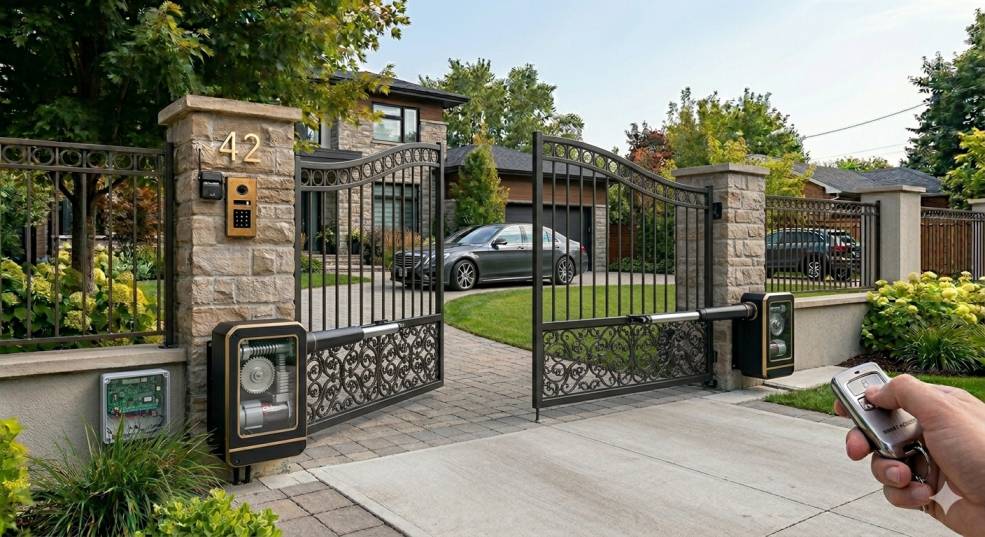
A. Swing Gates (Single or Double Leaf)
Swing gates are highly popular because of their classic aesthetic appeal and straightforward installation.
-
Single Leaf: A single gate panel that opens from one side. It is highly cost-effective but requires a wide, clear sweeping arc.
-
Double Leaf (Bi-Parting): Two panels that meet in the center. This design cuts the required sweeping depth in half and creates an elegant, grand entrance feel.
B. Sliding Gates
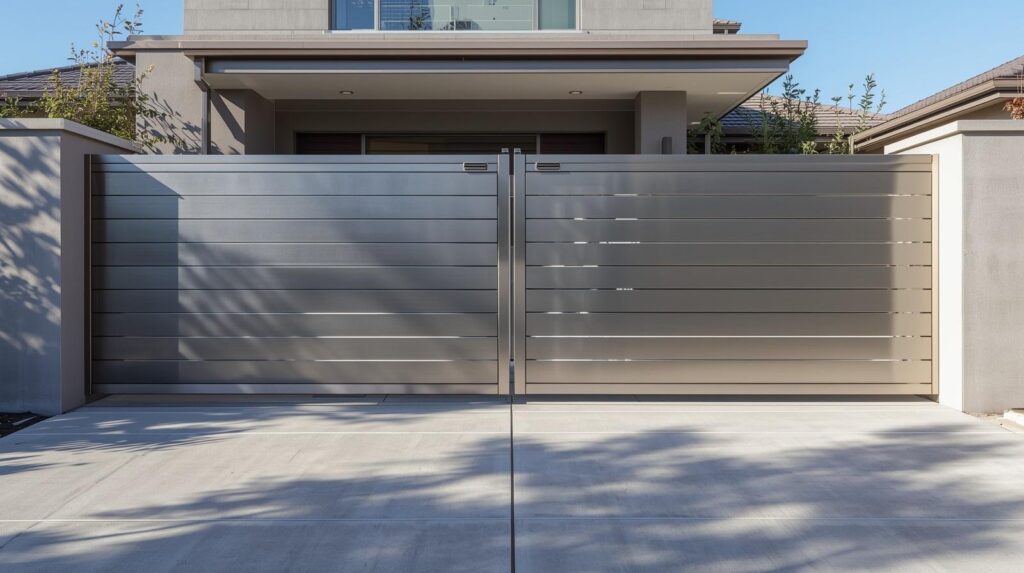
Sliding gates run on heavy-duty wheels along a rigid steel track anchored across your driveway opening. They are incredibly secure because they cannot be easily pushed open by brute force, and they require absolutely zero clearance depth inside the driveway. They are perfect for compact properties or homes with steep inclines.
C. Cantilever Gates
A smart variation of the sliding architecture, cantilever gates are suspended above the driveway surface, counterbalanced by an extended rear frame that rides inside enclosed roller assemblies. Because they never touch the ground, you don’t have to worry about dirt, leaves, snow, or uneven gravel jamming a track. This makes them exceptionally reliable, though they do require more total lateral space than a standard tracking gate.
3. Select a Material That Balances Style and Durability
The material you choose determines both the visual character of your home and how much long-term upkeep the system will require.
| Gate Material | Structural Lifespan | Maintenance Needs | Best Suited For |
| Wrought Iron | High (Decades) | Moderate (Requires periodic rust prevention) | Classic, ornate, and high-security architectural designs |
| Aluminum | High (Naturally corrosion-resistant) | Low (Simple soap and water rinse) | Modern, lightweight styles and coastal, humid environments |
| Natural Wood | Moderate (5-10 years before aging signs) | High (Regular sealing, painting, or staining) | Rustic, traditional homes requiring maximum privacy |
| Composite/Steel | High (Resistant to warping) | Low (UV-stabilized powder finishes) | High-durability privacy screens with a contemporary feel |
4. Match the Operator Motor to Your Real-World Usage
The operator motor is the heart of your entire automatic gate setup. Choosing a motor solely based on the lowest price tag is a recipe for premature system failure.
When planning your layout, it is always a good idea to consult an experienced team for professional gate opener installation and repair services. They can run structural calculations to ensure your motor has the perfect power reserves for your specific gate style.
5. Design a Seamless Access Control Infrastructure
An automated entrance is only as convenient as the access tools you use to control it. Modern systems offer a wide variety of ways to open your gate securely:
Integrating these options into an advanced, comprehensive access control system keeps your home incredibly secure while ensuring that visitors, family members, and emergency services can always enter without hassle.
6. Budgeting for Long-Term Ownership Costs
When figuring out the total cost of your new entrance, look beyond the initial purchase price of the gate panel and motor. A reliable automatic gate requires ongoing care to protect your investment.
To avoid unexpected breakdowns, plan for a professional automatic gate maintenance check at least once a year. A trained technician will check safety sensors, grease hidden bearings, adjust chain tension, and make sure internal electrical connections stay clear of water and pests. Investing in proactive care helps you avoid expensive emergency fixes down the road.
Key Summary Takeaways
-
Topography Always Wins: Never guess your driveway clearance or slope. Take precise measurements of depth, lateral width, and slope before buying any hardware.
-
Balance Materials and Upkeep: Aluminum is excellent for a low-maintenance, modern look. Natural wood offers beautiful privacy but requires regular sealing to prevent warping.
-
Don’t Skimp on the Motor: Always size your gate operator based on total panel weight and wind resistance to prevent early mechanical failures.
-
Prioritize Professional Layouts: Working with an expert installer ensures that all critical safety sensors, structural foundations, and electrical systems are set up correctly from day one.
Frequently Asked Questions (FAQ)
Which is safer: a swing automatic gate or a sliding automatic gate?
Both options are incredibly safe if they are installed with modern safety equipment like photo eye sensors and pressure-sensitive edges. However, sliding gates offer slightly higher security against forced entry because they are physically locked into a ground track and are much harder for an intruder to ram or push open by hand.
Can I run my home’s automatic gate system completely on solar power?
Absolutely. Many modern, high-efficiency 12V and 24V gate operators are built specifically for solar integration. If your driveway gets plenty of direct sunlight and you experience normal daily traffic, a solar panel paired with a deep-cycle backup battery will easily keep your system running cleanly without needing to trench expensive AC power lines down your driveway.
What happens to my automatic gate if my home loses power?
Every professional automatic gate opener includes a secure manual release mechanism. By using a specialized key or release lever, you can easily disengage the internal drive gears, allowing you to open and close the gate by hand until power is restored. Many systems also include internal battery backups that provide several full cycles during a power outage.
How much lateral space does a standard sliding gate require?
A sliding gate needs a clear, straight run along your property line that is equal to the total width of your driveway opening, plus an extra 3 to 5 feet to accommodate the motor mounting tail and structural support brackets. This entire path must stay completely clear of trees, utility boxes, and retaining walls.
Do I need a single swing or a double swing gate for my home?
If you have a very wide driveway opening (greater than 12 feet), a double swing gate is usually best. It splits the weight across two sets of posts and hinges, cuts the swinging depth clearance in half, and reduces the workload on each individual motor. For narrower driveways, a single swing gate is simpler and more economical.
Ready to Enhance Your Home’s Entrance?
Finding the perfect automatic gate means finding the right balance between beautiful design, reliable performance, and smart security. If you want to make sure your new installation is handled perfectly from the very start, the experienced team at Automatic Gates Warriors is here to guide you every step of the way.
We specialize in high-end, reliable automatic gate installation tailored to your property’s unique layout. Explore our full range of design options, learn about our commitment to quality craftsmanship on our about us page, or head straight over to our contact us page to request a professional on-site consultation today. If you ever run into operational issues down the road, you can always count on our fast, expert automatic gate repair services to keep your property safe and accessible.